Lyrics

Lyrics are words that make upwardly a song, usually consisting of verses and choruses. The author of lyrics is a lyricist. The words to an extended musical composition such equally an opera are, however, usually known as a "libretto" and their writer, as a "librettist". The meaning of lyrics can either exist explicit or implicit. Some lyrics are abstract, almost unintelligible, and, in such cases, their explication emphasizes course, articulation, meter, and symmetry of expression. Rappers can besides create lyrics (often with a variation of rhyming words) that are meant to be spoken rhythmically rather than sung.
Etymology
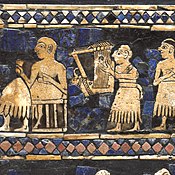
The give-and-take lyric derives via Latin lyricus from the Greek λυρικός ( lurikós ),[1] the adjectival form of lyre.[2] It starting time appeared in English in the mid-16th century in reference to the Earl of Surrey'due south translations of Petrarch and to his own sonnets.[3] Greek lyric verse had been divers by the mode in which it was sung accompanied by the lyre or cithara,[4] equally opposed to the chanted formal epics or the more passionate elegies accompanied by the flute. The personal nature of many of the verses of the 9 Lyric Poets led to the present sense of "lyric poetry" merely the original Greek sense of "lyric poesy"—"poetry accompanied past the lyre" i.e. "words set to music"—somewhen led to its utilize equally "lyrics", first attested in Stainer and Barrett'south 1876 Dictionary of Musical Terms.[5] Stainer and Barrett used the word equally a singular substantive: "Lyric, poetry or blank verse intended to be set to music and sung". Past the 1930s, the present use of the plurale tantum "lyrics" had begun; information technology has been standard since the 1950s for many writers.[1] The singular form "lyric" is still used to mean the complete words to a vocal by regime such every bit Alec Wilder,[6] Robert Gottlieb,[7] and Stephen Sondheim.[8] Notwithstanding, the atypical course is too commonly used to refer to a specific line (or phrase) within a vocal'south lyrics.
Poems
The differences between poem and song may become less meaningful where verse is set to music, to the point that any distinction becomes untenable. This is maybe recognised in the mode popular songs have lyrics.
However, the verse may pre-date its tune (in the way that "Rule Britannia" was ready to music, and "And did those feet in ancient time" has become the hymn "Jerusalem"), or the tune may be lost over time but the words survive, matched by a number of different tunes (this is particularly common with hymns and ballads).
Possible classifications proliferate (under anthem, ballad, blues, carol, folk song, hymn, libretto, lied, lullaby, march, praise song, circular, spiritual). Nursery rhymes may be songs, or doggerel: the term doesn't imply a stardom. The ghazal is a sung form that is considered primarily poetic. Run across also rapping, roots of hip hop music.
Analogously, verse drama might ordinarily be judged (at its best) as poetry, but not consisting of poems (run across dramatic poesy).
In Baroque music, melodies and their lyrics were prose. Rather than paired lines they consist of rhetorical sentences or paragraphs consisting of an opening gesture, an amplification (ofttimes featuring sequence), and a shut (featuring a cadence); in German Vordersatz-Fortspinnung-Epilog.[9] For instance:
When I was a kid, [opening gesture] I spoke every bit a child, [amplification...] I understood as a child, [...] I thought as a child; [...] But when I became a man, I put away kittenish things. [close] - i Corinthians xiii:11
Shifter
In the lyrics of popular music a "shifter"[x] is a give-and-take, often a pronoun, "where reference varies according to who is speaking, when and where",[11] such as "I", "you", "my", "our". For example, who is the "my" of "My Generation"?
Copyright and royalties
- Meet Royalties
Equally of 2021[update], there are many websites featuring song lyrics. This offering, all the same, is controversial, since some sites include copyrighted lyrics offered without the holder's permission. The U.S. Music Publishers Clan (MPA), which represents sail music companies, launched a legal campaign against such websites in December 2005. The MPA's president, Lauren Keiser, said the free lyrics spider web sites are "completely illegal" and wanted some website operators jailed.[12]
Lyrics licenses could exist obtained worldwide through one of the two aggregators: LyricFind and Musixmatch.[ citation needed ] The first company to provide licensed lyrics was Yahoo!, rapidly followed by MetroLyrics.[ citation needed ] Several lyric websites are providing licensed lyrics, such equally SongMeanings[13] and LyricWiki (defunct as of 2020).
Many competing lyrics spider web sites are still offering unlicensed content, causing challenges around the legality and accuracy of lyrics.[14] In an effort to crack down unlicensed lyrics web sites, a U.Southward. federal court has ordered LiveUniverse, a network of websites run by MySpace co-founder Brad Greenspan, to cease operating four sites offering unlicensed vocal lyrics.[15]
Academic study
Lyrics tin be studied from an academic perspective. For example, some lyrics can be considered a grade of social commentary. Lyrics often comprise political, social, and economic themes—as well as aesthetic elements—and so can communicate culturally significant messages. These messages can be explicit, or implied through metaphor or symbolism. Lyrics can also be analyzed with respect to the sense of unity (or lack of unity) it has with its supporting music. Analysis based on tonality and contrast are particular examples. Quondam Oxford Professor of Poetry Christopher Ricks famously published Dylan's Visions of Sin, an in-depth and characteristically Ricksian assay of the lyrics of Bob Dylan; Ricks gives the caveat that to have studied the poetry of the lyrics in tandem with the music would accept made for a much more complicated critical feat.
Search engines
Search gamble
A 2009 study published by McAfee establish that, in terms of potential exposure to malware, lyrics-related searches and searches containing the word "costless" are the near likely to have risky results from search engines, both in terms of average risk of all results, and maximum chance of whatever result.[16]
Showtime in belatedly 2014, Google changed its search results pages to include song lyrics. When users search for a name of a song, Google can now display the lyrics directly in the search results page.[17] When users search for a specific song'southward lyrics, most results show the lyrics directly through a Google search past using Google Play.[18]
Run across also
- Lyricist, a writer of lyrics
- Libretto, the "little volume" of an extended musical piece, written past a librettist
- "singing in the Spirit", vocal improvisation in a spiritual context
- scat singing & vocalese, vocal improvisation in jazz
- bol, kouji, beatbox, forms of vocal mimicry or percussion
References
- ^ a b "lyric". Oxford English language Lexicon (Online ed.). Oxford Academy Printing. Retrieved 2014-01-15 . (Subscription or participating institution membership required.)
- ^ Liddell, Henry & al. A Greek–English Dictionary 9th ed., " λυρικός ". Clarendon Press (Oxford), 1996. Hosted at the Perseus Project. Accessed 15 January 2014.
- ^ Sidney, Philip. An Apologie for Poetrie op. cit. OED (1903).
- ^ Miller, Andrew. Greek Lyric: An Anthology in Translation, pp. xii ff. Hackett Publishing (Indianapolis), 1996. ISBN 978-0872202917.
- ^ Stainer, John & al. A Dictionary of Musical Terms, p. 276. (London), 1876.
- ^ Wilder, Alec (1972). American Popular Song. New York: Oxford University Press. ISBN978-0195014457.
- ^ Gottlieb, Robert (2000). Reading Lyrics. New York: Pantheon Books. ISBN9780375400810.
- ^ Sondheim, Stephen (2011). Finishing the Hat. New York: Knopf. ISBN9780679439073.
- ^ Kelly, Thomas Forest (2011). Early Music: A Very Brusk Introduction, p.53. ISBN 978-0-19-973076-half dozen.
- ^ Durant (1984). Cited in Middleton, Richard (1990/2002). Studying Popular Music. Philadelphia: Open up University Printing. ISBN 0-335-15275-nine.
- ^ Middleton (1990), p.167.
- ^ "Song sites face legal crackdown". BBC News. 12 Dec 2005. Retrieved vii January 2007.
- ^ "Advertising on SongMeanings". SongMeanings. Retrieved 21 July 2012.
All of our lyrics are legally licensed through LyricFind.
- ^ Plambeck, Joseph (May 9, 2010). "Lyrics Sites at Middle of Fight Over Royalties". The New York Times . Retrieved May ix, 2010.
- ^ "Court Orders LiveUniverse to Shutter Unlicensed Lyrics Sites". Digital Media Wire. August 11, 2010. Archived from the original on Baronial xv, 2010. Retrieved September 5, 2010.
- ^ Keats, Shane; Koshy, Eipe (2009). "The Spider web's Most Dangerous Search Terms" (PDF). McAfee. Retrieved 21 July 2012.
- ^ Jose, Pagliery (23 December 2014). "Google now displays song lyrics in search results". CNN.com . Retrieved 23 December 2014.
- ^ "Google Play". play.google.com . Retrieved 2016-04-15 .
Further reading
- Moore, Allan F. (2003). Analyzing Pop Music. Cambridge Academy Press. ISBN978-1-139-43534-5.
External links
 | Wikiquote has quotations related to: Lyrics |
 | Look up lyrics or lyric in Wiktionary, the gratis dictionary. |
Source: https://en.wikipedia.org/wiki/Lyrics
0 Response to "Lyrics"
Post a Comment