What Will Crack Cocaine Do to a Developing Baby
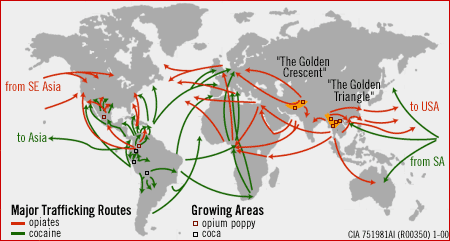
International drug routes
The illegal drug trade or drug trafficking is a global black market defended to the cultivation, industry, distribution and sale of prohibited drugs. Most jurisdictions prohibit trade, except under license, of many types of drugs through the use of drug prohibition laws. The think tank Global Financial Integrity'southward Transnational Crime and the Developing Earth report estimates the size of the global illicit drug marketplace between The states$426 and US$652billion in 2014 solitary.[one] With a earth GDP of US$78 trillion in the aforementioned year, the illegal drug merchandise may be estimated as virtually ane% of full global merchandise. Consumption of illegal drugs is widespread globally and it remains very difficult for local authorities to thwart its popularity.
History [edit]
Chinese authorities issued edicts against opium smoking in 1730, 1796 and 1800.[two] The W prohibited addictive drugs throughout the late 19th and early on 20th centuries.[iii] [4] [five]
In the early 19th century, an illegal drug trade in People's republic of china emerged. As a result, by 1838 the number of Chinese opium-addicts had grown to betwixt four and twelve million.[6] The Chinese regime responded by enforcing a ban on the import of opium; this led to the First Opium War (1839-1842) between the United Kingdom and Qing-dynasty China. The United kingdom won and forced People's republic of china to allow British merchants to sell Indian-grown opium. Trading in opium was lucrative, and smoking information technology had go common for the Chinese in the 19th century, and so British merchants increased trade with the Chinese. The Second Opium State of war bankrupt out in 1856, with the British joined this time by the French. After the ii Opium Wars, the British Crown, via the treaties of Nanking (1842), and Tianjin (1858), obligated the Chinese authorities to pay large sums of coin for opium they had seized and destroyed, which were referred to[ by whom? ] equally "reparations".
In 1868, as a result of the increased use of opium, the UK restricted the sale of opium in Great britain by implementing the 1868 Pharmacy Deed.[7] In the United states of america, control of opium remained under the control of individual U.s.a. states until the introduction of the Harrison Human activity in 1914, later on 12 international powers signed the International Opium Convention in 1912.
Between 1920 and effectually 1933 the Eighteenth Amendment to the U.s.a. Constitution banned alcohol in the United states of america. Prohibition proved almost impossible to enforce and resulted in the rise of organized crime, including the modern American Mafia, which identified enormous business opportunities in the manufacturing, smuggling and sale of illicit liquor.[8] [9]
The beginning of the 21st century saw drug use increase in North America and Europe, with a particularly increased need for marijuana and cocaine.[10] [11] As a effect, international organized crime syndicates such as the Sinaloa Dare and 'Ndrangheta take increased cooperation among each other in order to facilitate trans-Atlantic drug-trafficking.[12] Use of another illicit drug, hashish, has also increased in Europe.
Drug trafficking is widely regarded by lawmakers as a serious offense around the world. Penalties often depend on the blazon of drug (and its nomenclature in the country into which it is being trafficked), the quantity trafficked, where the drugs are sold and how they are distributed. If the drugs are sold to underage people, then the penalties for trafficking may be harsher than in other circumstances.
Drug smuggling carries severe penalties in many countries. Sentencing may include lengthy periods of incarceration, flogging and even the death penalization (in Singapore, Malaysia, Indonesia and elsewhere). In December 2005, Van Tuong Nguyen, a 25-twelvemonth-old Australian drug smuggler, was hanged in Singapore later on being convicted in March 2004.[xiii] In 2010, ii people were sentenced to death in Malaysia for trafficking 1 kilogram (two.2 lb) of cannabis into the state.[xiv] Execution is mostly used every bit a deterrent, and many have called upon much more than effective measures to be taken by countries to tackle drug trafficking;[15] for example, targeting specific criminal organisations that are oft also active in the smuggling of other goods (i.e. wild fauna) and even people.[16] [17] In many cases, links betwixt politicians and the criminal organisations have been proven to exist.[eighteen]
In June 2021, Interpol revealed an operation in 92 countries that close down 113,000 websites and online marketplaces selling counterfeit or illicit medicines and medical products a month earlier, led to the arrests of 227 people worldwide, recovered pharmaceutical products worth $23 million, and led to the seizure of approximately nine million devices and drugs, including large quantities of fake COVID-19 tests and face masks.[19]
Societal effects [edit]
The countries of drug production and transit are some of the most affected by the trade, though countries receiving the illegallyimported substances are too adversely afflicted. For example, Ecuador has captivated up to 300,000 refugees from Colombia who are running from guerrillas, paramilitaries and drug lords. While some applied for asylum, others are still illegal immigrants. The drugs that pass from Colombia through Ecuador to other parts of South America create economic and social problems.[20]
Honduras, through which an estimated 79% of cocaine passes on its way to the United states of america,[21] had, as of 2011, the highest murder rate in the globe.[22] According to the International Crisis Grouping, the most tearing regions in Central America, particularly along the Guatemala–Honduras border, are highly correlated with an affluence of drug trafficking activity.[23]
Trigger-happy offense [edit]
In many countries, the illegal drug trade is thought to be directly linked to violent crimes such as murder. This is specially truthful in all developing countries, such as Honduras, but is also an issue for many adult countries worldwide.[24] [25] In the late 1990s in the United States the Federal Bureau of Investigation estimated that 5% of murders were drug-related.[24] In Colombia, drug violence tin exist caused by factors such every bit the economic system, poor governments, and no authorization within police force enforcement.[26]
After a crackdown by Us and Mexican authorities in the get-go decade of the 21st century as part of tightened border security in the wake of the September 11 attacks, edge violence inside Mexico surged. The Mexican government estimates that 90% of the killings are drug-related.[27]
A study by the U.k. government's Drug Strategy Unit that was leaked to the printing, stated that due to the expensive price of highly addictive drugs heroin and cocaine, drug utilise was responsible for the keen majority of crime, including 85% of shoplifting, 70–eighty% of burglaries and 54% of robberies. It concluded that "[t]he cost of law-breaking committed to support illegal cocaine and heroin habits amounts to £16 billion a twelvemonth in the Great britain" [28]
Drug trafficking routes [edit]
Video of drug smugglers in loftier-speed boat dumping ii,300 pounds (i,000 kg) of cocaine in Eastern Pacific Sea - video from U.S. Coast Guard.

The nephews of President Nicolás Maduro, Efraín Antonio Campo Flores and Francisco Flores de Freitas, after their arrest by the U.Southward. Drug Enforcement Administration on ten November 2015.
Southward America [edit]
Venezuela has been a path to the U.s. and Europe for illegal drugs originating in Republic of colombia, through Primal America, Mexico and Caribbean countries such as Haiti, the Dominican Republic, and Puerto Rico.[ citation needed ]
According to the United Nations, there was an increase of cocaine trafficking through Venezuela since 2002.[29] In 2005, the government of Hugo Chávez severed ties with the United States Drug Enforcement Assistants (DEA), accusing its representatives of spying.[xxx] Following the divergence of the DEA from Venezuela and the expansion of DEA's partnership with Colombia in 2005, Venezuela became more attractive to drug traffickers.[31] Between 2008 and 2012, Venezuela'southward cocaine seizure ranking among other countries declined, going from being ranked 4th in the globe for cocaine seizures in 2008[32] to sixth in the world in 2012.[33]
On 18 November 2016, following what was known equally the Narcosobrinos incident, Venezuelan President Nicolás Maduro'south two nephews were found guilty of trying to transport drugs into the United States so they could "obtain a big amount of cash to assist their family stay in power".[34]
According to a enquiry conducted by the Israel-based Abba Eban Constitute as part of an initiative called Janus Initiative, the main routes that Hezbollah uses for smuggling drugs are from Colombia, Venezuela and Brazil into W Africa and and so transported through northern Africa into Europe. This route serves Hezbollah in making a profit in the cocaine smuggling marketplace to leverage it for terrorist activities.[35]
West Africa [edit]
Cocaine produced in Colombia and Bolivia increasingly has been shipped via W Africa (peculiarly in Nigeria, Greatcoat Verde, Guinea-bissau, Cameroon, Mali, Benin, Togo, and Republic of ghana).[36] The money is frequently laundered in countries such as Nigeria, Republic of ghana, and Senegal.
According to the Africa Economic Found, the value of illicit drug smuggling in Republic of guinea-bissau is almost twice the value of the land's GDP.[36] Law officers are often bribed. A constabulary officeholder's normal monthly wage of $93 is less than ii% of the value of 1 kilogram (ii.2 lb) of cocaine (€7000 or $8750).[ citation needed ] The coin can also exist laundered using real estate. A house is built using illegal funds, and when the house is sold, legal money is earned.[37] When drugs are sent over land, through the Sahara, the drug traders accept been forced to cooperate with terrorist organizations, such equally Al Qaida in Islamic Maghreb.[38] [39]
Eastern and Southern Africa [edit]
Heroin is increasingly trafficked from Transitional islamic state of afghanistan to Europe and America through eastern and southern African countries. This path is known as the "southern route" or "smack rails." Repercussions of this merchandise include burgeoning heroin apply and political corruption among intermediary African nations.[twoscore]
Asia [edit]
Drugs in Asia traditionally traveled the southern routes – the master caravan axes of Southeast Asia and Southern People's republic of china – and include the former opium-producing countries of Thailand, Iran, and Pakistan.[41] Afterward the 1990s, especially after the end of the Cold State of war (1991), borders were opened and trading and customs agreements were signed so that the routes expanded to include Mainland china, Central Asia, and Russia.[41] In that location are, therefore, diversified drug trafficking routes bachelor today, particularly in the heroin trade and these thrive due to the continuous development of new markets. A large amount of drugs are smuggled into Europe from Asia. The main sources of these drugs are Afghanistan, along with countries that constituted the so-chosen Golden Crescent. From these producers, drugs are smuggled into the Due west and Primal Asia to its destinations in Europe and the U.s.a..[42] Iran is now the route for smugglers, having been previously a principal trading route, due to its big-scale and costly state of war against drug trafficking.[41] The Border Police Chief of Iran said that his country "is a strong bulwark confronting the trafficking of illegal drugs to Caucasus, especially the Azerbaijan."[43] The drugs produced past the Golden Triangle of Myanmar, Laos, and Thailand, on the other manus, pass through the southern routes to feed the Australian, U.S., and Asian markets.[44]
Online [edit]
Drugs are increasingly traded online on the dark web on darknet markets. The platform Silk Road provided goods and services to 100,000 buyers before existence shut downwards in October 2013.[45] [46] This prompted the creation of new platforms such as Silk Road 2.0, which were as well shut down.[47]
Profits [edit]

US$207 million and boosted amounts in other currencies were confiscated from Mexican Zhenli Ye Gon in 2007.

Hashish seized in Operation Albatross, a articulation operation of Afghan officials, NATO, and the DEA
Statistics almost profits from the drug trade are largely unknown due to its illicit nature. An online written report published by the Uk Home Part in 2007 estimated the illicit drug marketplace in the United kingdom at £four–6.6 billion a year[48]
In December 2009 United nations Office on Drugs and Crime Executive Director Antonio Maria Costa claimed illegal drug coin saved the banking industry from collapse. He claimed he had seen evidence that the proceeds of organized crime were "the only liquid investment capital" available to some banks on the brink of collapse during 2008. He said that a majority of the $352 billion (£216bn) of drug profits was captivated into the economic organisation as a upshot:
"In many instances, the coin from drugs was the only liquid investment capital. In the second half of 2008, liquidity was the banking system'southward main problem and hence liquid capital became an of import factor...Inter-bank loans were funded by money that originated from the drugs merchandise and other illegal activities...there were signs that some banks were rescued that style".[49]

five cm hashish packages taken from a smuggler by police.
Costa declined to identify countries or banks that may have received any drug money, saying that would be inappropriate because his office is supposed to address the trouble, not apportion blame.
Though street-level drug sales are widely viewed as lucrative, a report by Sudhir Venkatesh suggested that many low-level employees receive low wages. In a written report he made in the 1990s working closely with members of the Black Gangster Disciple Nation in Chicago, he found that one gang (essentially a franchise) consisted of a leader (a higher graduate named J.T.), iii senior officers, and 25 to 75 street level salesmen ('pes soldiers') depending on season. Selling crevice cocaine, they took in approximately $32,000 per month over a half dozen-year period. This was spent as follows: $5,000 to the lath of twenty directors of the Black Gangster Disciple Nation, who oversaw 100 such gangs for approximately $500,000 in monthly income. Another $5,000 monthly was paid for cocaine, and $4,000 for other non-wage expenses. J.T. took $8,500 monthly for his own salary. The remaining $9,500 monthly went to pay the employees a $vii per hour wage for officers and a $iii.30 per hour wage for foot soldiers. Opposite to a popular image of drug sales as a lucrative profession, many of the employees were living with their mothers by necessity. Despite this, the gang had iv times as many unpaid members who dreamed of becoming foot soldiers.[50]
Complimentary trade link [edit]
There are several arguments on whether or non gratuitous trade has a correlation to an increased activity in the illicit drug trade. Currently, the structure and performance of the illicit drug industry is described mainly in terms of an international division of labor.[51] Free trade tin open new markets to domestic producers who would otherwise resort to exporting illicit drugs. Additionally, all-encompassing free merchandise amongst states increases cross-border drug enforcement and coordination betwixt constabulary enforcement agencies in different countries.[51] Withal, complimentary trade as well increases the sheer volume of legal cross-edge trade and provides embrace for drug smuggling—past providing aplenty opportunity to conceal illicit cargo in legal trade. While international gratuitous merchandise continues to expand the volume of legal trade, the ability to observe and interdict drug trafficking is severely macerated. Towards the belatedly 1990s, the acme x seaports in the world processed 33.6 meg containers.[51] Free merchandise has fostered integration of financial markets and has provided drug traffickers with more opportunities to wash coin and invest in other activities. This strengthens the drug industry while weakening the efforts of constabulary enforcement to monitor the flow of drug money into the legitimate economy. Cooperation among cartels expands their scope to distant markets and strengthens their abilities to evade detection by local constabulary enforcement.[51] Additionally, criminal organizations work together to coordinate money-laundering activities by having separate organizations handle specific stages of laundering procedure.[51] 1 organization structures the process of how financial transactions will be laundered, while another criminal group provides the "dirty" money to be cleaned.[51] By fostering expansion of trade and global transportation networks, free merchandise encourages cooperation and germination of alliances amongst criminal organizations beyond unlike countries. The drug trade in Latin America emerged in the early on 1930s.[52] It saw significant growth in the Andean countries, including Peru, Republic of bolivia, Chile, Ecuador, Republic of colombia and Venezuela.[52] The clandestine market in the early half of the 20th century mainly had ties to Europe. Afterward World War II, the Andean countries saw an expansion of merchandise, specifically with cocaine.[52]
Drug trafficking past country [edit]
The states [edit]

Background [edit]
The effects of the illegal drug merchandise in the The states can be seen in a range of political, economic and social aspects. Increasing drug related violence can be tied to the racial tension that arose during the late 20th century along with the political upheaval prevalent throughout the 1960s and 70s.[ citation needed ] The second half of the 20th century was a menses when increased wealth, and increased discretionary spending, increased the demand for illicit drugs in certain areas of the U.s.. Large-scale drug trafficking is one of the few capital crimes, and may issue in a death sentence prescribed at the federal level when it involves killing.
Political impact [edit]
A large generation, the babe boomers, came of age in the 1960s. Their social tendency to confront the law on specific problems, including illegal drugs, overwhelmed the understaffed judicial system. The federal government attempted to enforce the police force, but with meager result.[ citation needed ]
Marijuana was a popular drug seen through the Latin American trade route in the 1960s. Cocaine became a major drug product in the later decades.[53] Much of the cocaine is smuggled from Republic of colombia and Mexico via Jamaica.[54] This led to several administrations combating the popularity of these drugs. Due to the influence of this development on the U.S. economy, the Reagan administration began "certifying" countries for their attempts at controlling drug trafficking.[53] This allowed the United States to intervene in activities related to illegal drug send in Latin America. Continuing into the 1980s, the Usa instated stricter policy pertaining to drug transit through sea. As a result, in that location was an influx in drug-trafficking across the Mexico–U.S. border. This increased the drug cartel activity in Mexico. By the early 1990s, so much every bit 50% of the cocaine bachelor in the United States marketplace originated from Mexico, and by the 2000s, over 90% of the cocaine in the Usa was imported from Mexico.[53] In Colombia, still, there was a fall of the major drug cartels in the mid-1990s. Visible shifts occurred in the drug market in the Us. Between the 1996 and 2000, U.S. cocaine consumption dropped by 11%.[55]
In 2008, the U.S. authorities initiated another program, known as the Merida Initiative, to help gainsay drug trafficking in Mexico. This program increased U.S. security assistance to $ane.4 billion over several years, which helped supply Mexican forces with "high-end equipment from helicopters to surveillance technology".[56] Despite U.S. help, Mexican "narcogangs" go on to outnumber and outgun the Mexican Army, assuasive for continued activities of drug cartels across the U.South.–Mexico border.[56]
[edit]

War on drugs in Arizona, Oct 2011
Although narcotics are illegal in the US, they have become integrated into the nation's culture and are seen as a recreational activity past sections of the population.[57] Illicit drugs are considered to be a commodity with potent need, as they are typically sold at a high value. This high price is caused by a combination of factors that include the potential legal ramifications that be for suppliers of illicit drugs and their high need.[58] Despite the abiding attempt by politicians to win the war on drugs, the US is notwithstanding the earth's largest importer of illegal drugs.[58]
Throughout the 20th century, narcotics other than cocaine also crossed the Mexican border, coming together the US demand for alcohol during the 1920s Prohibition, opiates in the 1940s, marijuana in the 1960s, and heroin in the 1970s.[59] About of the U.S. imports of drugs come from Mexican drug cartels. In the United States, around 195 cities have been infiltrated past drug trafficking that originated in Mexico.[57] An estimated $10bn of the Mexican drug cartel's profits come from the United States, not just supplying the Mexican drug cartels with the profit necessary for survival, just also furthering America's economic dependence on drugs.[57]
Demographics [edit]
With a big wave of immigrants in the 1960s and onwards, the United States saw an increased heterogeneity in its public.[60] In the 1980s and 90s, drug-related homicide was at a record high. This increment in drug violence became increasingly tied to these ethnic minorities. Though the rate of violence varied tremendously amongst cities in America, it was a mutual anxiety in communities across urban America. An instance of this could be seen in Miami, a city with a host of ethnic enclaves.[60] Between 1985 and 1995, the homicide rate in Miami was i of the highest in the nation—four times the national homicide boilerplate. This law-breaking charge per unit was correlated with regions with low employment and was non entirely dependent on ethnicity.[60]
The baby boomer generation also felt the effects of the drug merchandise in their increased drug utilise from the 1960s to 80s.[61] Along with substance use, criminal involvement, suicide and murder were too on the rise. Due to the large corporeality of baby boomers, commercial marijuana apply was on the rise. This increased the supply and need for marijuana during this fourth dimension period.[61]
Mexico [edit]
Political influences [edit]
Corruption in Mexico has contributed to the domination of Mexican cartels in the illicit drug merchandise. Since the beginning of the 20th century, Mexico's political surroundings allowed the growth of drug-related activity. The loose regulation over the transportation of illegal drugs and the failure to prosecute known drug traffickers and gangs increased the growth of the drug industry. Toleration of drug trafficking has undermined the dominance of the Mexican government and has decreased the ability of police force enforcement officers in regulation over such activities. These policies of tolerance fostered the growing power of drug cartels in the Mexican economy and accept made drug traders wealthier.[62] Many states in Mexico lack policies that establish stability in governance. In that location besides is a lack of local stability, equally mayors cannot be re-elected. This requires electing a new mayor each term. Drug gangs have manipulated this, using vacuums in local leadership to their own advantage.[53]

In 1929, the Institutional Revolutionary Party (PRI) was formed to resolve the chaos resulting from the Mexican Revolution. Over time, this party gained political influence and had a major bear upon on Mexico's social and economical policies.[53] The party created ties with various groups as a ability play in order to gain influence, and as a result created more corruption in the authorities. One such power play was an brotherhood with drug traffickers. This political abuse obscured justice, making it difficult to place violence when it related to drugs.[63] By the 1940s, the tie betwixt the drug cartels and the PRI had solidified. This system created immunity for the leaders of the drug cartels and allowed drug trafficking to abound nether the protection of the authorities officials. During the 1990s, the PRI lost some elections to the new National Action Party (PAN). Anarchy once again emerged as elected government in Mexico changed drastically.[64] Equally the PAN party took control, drug dare leaders took advantage of the ensuing defoliation and used their existing influence to farther gain power.[64] Instead of negotiating with the primal government as was done with the PRI party, drug cartels utilized new means to distribute their supply and continued operating through forcefulness and intimidation.[64] Every bit Mexico became more democratized, the corruption fell from a centralized power to the local authorities.[64] Cartels began to bribe local authorities, thus eliminating the structure and rules placed by the regime—giving cartels more freedom.[64] Every bit a response, Mexico saw an increase in violence acquired by drug trafficking.
The abuse cartels created resulted in distrust of regime by the Mexican public.[64] This distrust became more prominent after the collapse of the PRI party.[64] In response, the presidents of Mexico, in the late twentieth century and early on twenty-first century, implemented several different programs relating to law enforcement and regulation. In 1993, President Salinas created the National Found for the Combat of Drugs in Mexico. From 1995 to 1998, President Zedillo established policies regarding increased punishment of organized crime, allowing "[wire taps], protected witnesses, covert agents and seizures of goods", and increasing the quality of law enforcement at the federal level. From 2001 to 2005, President Vicente Fox created the Federal Bureau of Investigation.[62] These policies resulted in the arrests of major drug-trafficking bosses:
| Twelvemonth | Person | Cartel |
|---|---|---|
| 1989 | Miguel Angel Felix Gallardo | Guadalajara Cartel |
| 1993 | Joaquín Archivaldo Guzmán Loera | Sinaloa Cartel |
| 1995 | Héctor Luis Palma Salazar | Sinaloa Cartel |
| 1996 | Juan Garcia Abrego | Gulf Dare |
| 2002 | Ismael Higuera Guerrero[62] | Tijuana Cartel |
| Jesus Labra | Tijuana Cartel | |
| Adan Amezcua | Colima Dare | |
| Benjamin Arellano Felix | Tijuana Dare | |
| 2003 | Osiel Cardenas[62] | Gulf Cartel |
Mexico'due south economic system [edit]
Over the by few decades drug cartels have get integrated into Mexico'due south economy. Approximately 500 cities are directly engaged in drug trafficking and nearly 450,000 people are employed by drug cartels.[64] Additionally, the livelihood of 3.two million people is dependent on the drug cartels.[64] Between local and international sales, such every bit to Europe and the Us, drug cartels in United mexican states see a $25–30bn yearly turn a profit, a great bargain of which circulates through international banks such as HSBC.[64] Drug cartels are key in local economics. A percentage of the profits seen from the trade are invested in the local community.[64] Such profits contribute to the education and healthcare of the customs.[64] While these cartels bring violence and hazards into communities, they create jobs and provide income for its many members.[64]
Culture of drug cartels [edit]
Major cartels saw growth due to a prominent set culture of Mexican order that created the means for drug upper-case letter. One of the sites of origin for drug trafficking within Mexico, was the state of Michoacán. In the past, Michoacán was mainly an agricultural club. This provided an initial growth of trade. Industrialization of rural areas of Mexico facilitated a greater distribution of drugs, expanding the drug market into different provinces.[63] One time towns became industrialized, cartels such as the Sinaloa Dare started to form and expand. The proliferation of drug cartel culture largely stemmed from the ranchero culture seen in Michoacán. Ranchero culture values the individual as opposed to the society as a whole.[63] This culture fostered the drug civilisation of valuing the family that is formed within the cartel. This ideal allowed for greater organization within the cartels. Gangs play a major role in the activity of drug cartels. MS-xiii and the 18th Street gang are notorious for their contributions and influence over drug trafficking throughout Latin America. MS-xiii has controlled much of the activity in the drug trade spanning from Mexico to Panama.[65] Female involvement is present in the Mexican drug culture. Although females are not treated equally equals to males, they typically agree more power than their civilization allows and acquire some independence. The increase in power has attracted females from higher social classes.[66] Financial gain has also prompted women to get involved in the illegal drug marketplace. Many women in the lower levels of major drug cartels belong to a low economical class. Drug trafficking offers women an attainable manner to earn income.[66] Females from all social classes have get involved in the trade due to outside pressure from their social and economic environments.
Republic of colombia [edit]

Seized drugs in Bogota, Republic of colombia, April 2013
Political ties [edit]
It was mutual for smugglers in Colombia to import liquor, alcohol, cigarettes and textiles, while exporting cocaine.[52] Personnel with noesis of the terrain were able to supply the local market place while also exporting a large amount of product.[52] The established trade that began in the 1960s involved Peru, Bolivia, Colombia, Venezuela and Cuba. Peasant farmers produced coca paste in Peru and Republic of bolivia, while Colombian smugglers would process the coca paste into cocaine in Colombia, and trafficked product through Cuba.[52] This trade route established ties between Cuban and Colombian organized crime. From Cuba, cocaine would be transported to Miami, Florida; and Spousal relationship City, New Jersey. Quantities of the drug were then smuggled throughout the Us.[52] The international drug trade created political ties between the involved countries, encouraging the governments of the countries involved to collaborate and instate common policies to eradicate drug cartels. Cuba stopped being a center for transport of cocaine following the establishment of a communist government in 1959. As a result, Miami and Union Metropolis became the sole locations for trafficking.[52] The relations between Cuban and Colombian organized criminal offense remained potent until the 1970s, when Colombian cartels began to vie for power. In the 1980s and 90s, Colombia emerged equally a central correspondent of the drug merchandise industry in the Western Hemisphere. While the smuggling of drugs such as marijuana, poppy, opium and heroin became more ubiquitous during this time period, the activity of cocaine cartels collection the development of the Latin American drug trade. The merchandise emerged every bit a multinational effort as supplies (i.e. coca plant substances) were imported from countries such as Bolivia and Republic of peru, were refined in Colombian cocaine labs and smuggled through Colombia, and exported to countries such every bit the US.
Republic of colombia's economy [edit]
Republic of colombia has had a significant role in the illegal drug trade in Latin America. While agile in the drug trade since the 1930s, Colombia'south role in the drug trade did non truly go dominant until the 1970s. When Mexico eradicated marijuana plantations, demand stayed the same. Colombia met much of the demand by growing more marijuana. Grown in the strategic northeast region of Republic of colombia, marijuana presently became the leading cash crop in Colombia.[52] This success was short-lived due to anti-marijuana campaigns that were enforced by the US war machine throughout the Caribbean.[52] Instead, drug traffickers in Colombia continued their focus on exporting cocaine.[52] Having been an export of Colombia since the early 1950s, cocaine remained popular for a host of reasons. Republic of colombia's location facilitated its transportation from South America into Central America, and then to its destination of Northward America. This connected into the 1990s, when Republic of colombia remained the primary exporter of cocaine.[55] The business of drug trafficking tin exist seen in several stages in Colombia towards the latter one-half of the 20th century. Republic of colombia served as the ascendant force in the distribution and sale of cocaine past the 1980s. As drug producers gained more power, they became more centralized and organized into what became drug cartels.[55] Cartels controlled the major aspects of each stage in the traffic of their product. Their arrangement allowed cocaine to be distributed in great amounts throughout the United States. Past the tardily 1980s, intra-industry strife arose within the cartels.[55] This stage was marked past increased violence as different cartels fought for control of export markets. Despite this strife, this ability struggle led to then having multiple producers of coca leaf farms. This in turn caused an comeback in quality control and reduction of police interdiction in the distribution of cocaine.[55] This likewise led to cartels attempting to repatriate their earnings which would eventually make up 5.v% of Republic of colombia's Gdp.[55] This drive to repatriate earnings led to the pressure of legitimizing their wealth, causing an increase in violence throughout Colombia.[55]

Throughout the 1980s, estimates of illegal drug value in Republic of colombia ranged from $2bn to $4bn. This fabricated upwards about vii–10% of the $36bn estimated GNP of Colombia during this decade. In the 1990s, the estimates of the illegal drug value remained roughly within the aforementioned range (~$2.5bn). As the Colombian GNP rose throughout the 1990s ($68.5bn in 1994 and $96.3bn in 1997), illegal drug values began to comprise a decreasing fraction of the national economic system. By the early on 1990s, although Colombia led in the exportation of cocaine, it institute increasing confrontations within its country. These confrontations were primarily between cartels and government institutions. This led to a decrease in the drug trade's contribution to the GDP of Republic of colombia; dropping from five.5% to 2.vi%.[55] Though a contributor of wealth, the distribution of cocaine has had negative effects on the socio-political situation of Colombia and has weakened its economic system equally well.[55]
[edit]
Past the 1980s, Colombian cartels became the dominant cocaine distributors in the Us.[52] This led to the spread of increased violence throughout both Latin America and Miami.[52] In the 1980s, two major drug cartels emerged in Colombia: the Medellin and Cali groups. Throughout the 1990s even so, several factors led to the refuse of these major cartels and to the rise of smaller Colombian cartels. The U.South. need for cocaine dropped while Colombian production rose, pressuring traffickers to find new drugs and markets. In this time period, there was an increase in activity of Caribbean cartels that led to the rise of an alternate road of smuggling through United mexican states. This led to the increased collaboration between major Colombian and Mexican drug traffickers. Such desperate changes in the execution of drug trade in Colombia paired with the political instabilities and rise of drug wars in Medellin and Cali, gave way for the rise of the smaller Colombian drug trafficking organizations (and the rising of heroin trade). Equally the drug trade's influence over the economy increased, drug lords and their networks grew in their power and influence in guild. The occurrences in drug-related violence increased during this fourth dimension flow as drug lords fought to maintain their command in the economy. Typically a drug dare had support networks that consisted of a number of individuals. These people individuals ranged from those directly involved in the trade (such as suppliers, chemists, transporters, smugglers, etc.) equally well as those involved indirectly in the trade (such as politicians, bankers, constabulary, etc.). Every bit these smaller Colombian drug cartels grew in prevalence, several notable aspects of the Colombian guild gave way for further development of the Colombian drug industry. For instance, until the late 1980s, the long-term effects of the drug industry were not realized by much of guild. Additionally, there was a lack of regulation in prisons where captured traffickers were sent. These prisons were under-regulated, under-funded, and under-staffed, which allowed for the formation of prison gangs, for the smuggling of arms/weapons/etc., for viable escapes, and fifty-fifty for captured drug lords to continue running their businesses from prison.
Trade in specific drugs [edit]
Cannabis [edit]
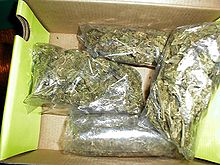
While the recreational use of (and consequently the distribution of) cannabis is illegal in most countries throughout the world, recreational distribution is legal in some countries, such as Canada, and medical distribution is permitted in some places, such every bit 10 of the 50 U.s.a. states (although importation and distribution is still federally prohibited).[68] First in 2014, Uruguay became the start land to legalize cultivation, auction, and consumption of cannabis for recreational use for adult residents.[69] In 2018, Canada became the second state to legalize use, sale and tillage of cannabis. The offset few weeks were met with extremely loftier need, most shops beingness out of stock later operating for just four days.
Cannabis utilise is tolerated in some areas, most notably the netherlands which has legalized the possession and licensed auction (but non cultivation) of the drug. Many nations have decriminalized the possession of minor amounts of marijuana. Due to the hardy nature of the cannabis plant, marijuana is grown all across the world and is today the world's most popular illegal drug with the highest level of availability.[70] Cannabis is grown legally in many countries for industrial, non-drug employ (known as hemp) as well. Cannabis-hemp may also exist planted for other non-drug domestic purposes, such equally seasoning that occurs in Aceh.[71]
The demand for cannabis effectually the globe, coupled with the drug's relative ease of cultivation, makes the illicit cannabis trade ane of the primary ways in which organized criminal groups finance many of their activities. In Mexico, for example, the illicit trafficking of cannabis is thought to constitute the majority of many of the cartels' earnings,[72] and the principal way in which the cartels finance many other illegal activities; including the purchase of other illegal drugs for trafficking, and for acquiring weapons that are ultimately used to commit murders (causing a burgeoning in the homicide rates of many areas of the world, just especially Latin America).[73] [74]
Some studies show that the increased legalization of cannabis in the United States (get-go in 2012 with Washington Initiative 502 and Colorado Amendment 64) has led Mexican cartels to smuggle less cannabis in exchange for more than heroin.[75] [76] [77]
Booze [edit]
Alcohol, in the context of alcoholic beverages rather than denatured alcohol, is illegal in a number of Muslim countries, such as Kingdom of saudi arabia, and this has resulted in a thriving illegal trade in alcohol.[78] [ vague ] The industry, auction, transportation, importation and exportation of alcoholic potable were illegal in the U.s. during the time known as the Prohibition in the 1920s and early 1930s.
Heroin [edit]


In the 1950s and 1960s, almost heroin was produced in Turkey and transshipped in France via the French Connection law-breaking ring, with much arriving in the United States.[79] This resulted in the record setting April 26, 1968 seizure of 246 lb (111.six kg) of heroin smuggled in a vehicle on the SS French republic (1960) body of water liner. [eighty] [81] [82] Past the time of The French Connectedness (1971 film), this route was beingness supplanted.[79]
Then, until around 2004, the majority of the globe'south heroin was produced in an area known every bit the Aureate Triangle.[83] [ page needed ] Withal, past 2007, 93% of the opiates on the earth marketplace originated in Transitional islamic state of afghanistan.[84] This amounted to an export value of well-nigh US$4 billion, with a quarter being earned past opium farmers and the rest going to commune officials, insurgents, warlords and drug traffickers.[85] Another significant expanse where poppy fields are grown for the manufacture of heroin is Mexico.
According to the United States Drug Enforcement Administration, the price of heroin is typically valued 8 to x times that of cocaine on American streets, making information technology a high-turn a profit substance for smugglers and dealers.[86] In Europe (except the transit countries Portugal and the Netherlands), for instance, a purported gram of street heroin, usually consisting of 700–800 mg of a calorie-free to dark brown powder containing 5–10% heroin base, costs €30–lxx, making the effective value per gram of pure heroin €300–700. Heroin is generally a preferred product for smuggling and distribution—over unrefined opium due to the cost-effectiveness and increased efficacy[ citation needed ] of heroin.
Because of the high price per book, heroin is easily smuggled. A US quarter-sized (2.v cm) cylindrical vial can contain hundreds of doses. From the 1930s to the early 1970s, the and so-called French Connectedness supplied the bulk of United states of america demand. Allegedly, during the Vietnam State of war, drug lords such as Ike Atkinson used to smuggle hundreds of kilograms of heroin to the U.s. in coffins of dead American soldiers (run into Cadaver Connectedness). Since that fourth dimension information technology has go more difficult for drugs to be imported into the The states than information technology had been in previous decades, but that does not stop the heroin smugglers from getting their production across US borders. Purity levels vary greatly by region with Northeastern cities having the most pure heroin in the United States.[ commendation needed ] On 17 October 2018 police force in Genoa Italy, discovered 270 kg of heroin hidden in a ship coming from the Iranian southern port of Bandar Abbas. The send had already passed and stopped at Hamburg in Germany and Valencia in Spain.[87]
Penalties for smuggling heroin or morphine are often harsh in about countries. Some countries will readily hand down a death penalty (e.grand. Singapore) or life in prison for the illegal smuggling of heroin or morphine, which are both internationally Schedule I drugs under the Single Convention on Narcotic Drugs.[ citation needed ]
In May 2021, Romania seized i.4 tonnes of heroin at Constanța port of a shipment from Iran that was headed for Western Europe.[88]
Methamphetamine [edit]

Methamphetamine smuggled inside a auto tire
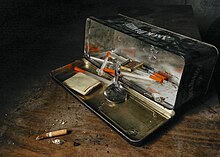
Heroin or methamphetamine drug utilise kit ("works") with needles and a spoon
Methamphetamine is another pop drug among distributors. 3 common street names are "meth", "crank", and "water ice".[89]
Co-ordinate to the Community Epidemiology Work Grouping, the number of clandestine methamphetamine laboratory incidents reported to the National Underground Laboratory Database decreased from 1999 to 2009. During this period, methamphetamine lab incidents increased in mid-western States (Illinois, Michigan, Missouri, and Ohio), and in Pennsylvania. In 2004, more lab incidents were reported in Missouri (2,788) and Illinois (1,058) than in California (764). In 2003, methamphetamine lab incidents reached new highs in Georgia (250), Minnesota (309), and Texas (677). There were only 7 methamphetamine lab incidents reported in Hawaii in 2004, though nigh 59 percentage of substance use handling admissions (excluding alcohol) were for primary methamphetamine use during the first six months of 2004. As of 2007, Missouri leads the United States in drug-lab seizures, with 1,268 incidents reported.[90] Often canine units are used for detecting rolling meth labs which tin can be curtained on large vehicles, or transported on something as small-scale as a motorcycle. These labs are more difficult to detect than stationary ones, and can oft be obscured amid legal cargo in big trucks.[91]
Methamphetamine is sometimes used intravenously, placing users and their partners at risk for manual of HIV and hepatitis C.[92] "Meth" can also be inhaled, most ordinarily vaporized on aluminum foil or in a glass piping. This method is reported to give "an unnatural high" and a "cursory intense rush".[93]
In South Africa methamphetamine is called "tik" or "tik-tik"."Known locally as "tik," the substance was well-nigh unknown as late as 2003. At present, it is the country's main addictive substance, even when booze is included. "[94] Children as immature as eight are abusing the substance, smoking it in rough glass vials fabricated from light bulbs.[ citation needed ] Since methamphetamine is easy to produce, the substance is manufactured locally in staggering quantities.[ citation needed ]
The authorities of Democratic people's republic of korea currently operates methamphetamine production facilities. There, the drug is used every bit medicine because no alternatives are available; information technology also is smuggled across the Chinese border.[95]
The Australian Crime Commission's illicit drug information report for 2011–2012 stated that the average strength of crystal methamphetamine doubled in well-nigh Australian jurisdictions within a 12-month period, and the bulk of domestic laboratory closures involved small "addict-based" operations.[96]
Temazepam [edit]
Temazepam, a strong hypnotic benzodiazepine, is illicitly manufactured in clandestine laboratories (called jellie labs) to supply the increasingly high need for the drug internationally.[97] Many clandestine temazepam labs are in Eastern Europe. The labs manufacture temazepam by chemically altering diazepam, oxazepam or lorazepam.[98] "Jellie labs" have been identified and shut down in Russia, Ukraine, Latvia and Republic of belarus.[99]
Surveys in many countries show that temazepam, MDMA, nimetazepam, and methamphetamine rank among the elevation illegal addictive substances used.[100] [101] [102] [103] [104] [105] [106] [107] [108] [109] [110]
Cocaine [edit]

Prostitutes buy cocaine capsules from a drug dealer in Berlin, 1930. The capsules sold for five marks each.
Cocaine is a highly prominent drug among many drug dealers and manufacturers. The cocaine black marketplace distribution industry is worth more than than 85 billion dollars. It has been a heavily fought over and massively produced. Around 1.1 meg kilograms of cocaine were made in 2009 and it is believed to have been consumed by effectually 17 million people worldwide. This drug's mass merchandise is believed to accept been possible by notorious drug dealing kingpin Joaquín "El Chapo" Guzmán who ran the Sinaloa Cartel.[111]
Run into also [edit]
- Allegations of CIA drug trafficking
- Arguments for and against drug prohibition
- Counterfeit medications
- Drug liberalization
- Drug trafficking organizations
- Illegal drug merchandise in the Indian Body of water region
- List of media portraying drug smuggling
- Maritime drug smuggling into Commonwealth of australia
- Narco-capitalism
- Operation Show Me How
International coordination [edit]
- Interpol
- Un Convention Against Illicit Traffic in Narcotic Drugs and Psychotropic Substances
References [edit]
- ^ May, Channing (March 2017). "Transnational Crime and the Developing World" (PDF). Global Fiscal Integrity: 3. Retrieved 23 Baronial 2021.
- ^ "History of the Opium Trade in China". Druglibrary.org . Retrieved 8 October 2018.
- ^ "Illegal Drugs in America: A Modernistic History". Deamuseum.org. Archived from the original on 2004-12-04. Retrieved 2011-xi-26 .
- ^ "The 1912 Hague International Opium Convention". Druglibrary.org. Retrieved 2011-11-26 .
- ^ "History of Legislative Control Over Opium, Cocaine, and Their Derivatives". Druglibrary.org. Retrieved 2011-11-26 .
- ^ Hanes, William Travis; Sanello, Frank (2004). The Opium Wars: The Addiction of One Empire and the Corruption of Another . Sourcebooks, Inc. p. 34. ISBN978-1-4022-0149-3.
- ^ Berridge, Virginia; Edwards, Griffith (1981). Opium and the People, Opiate Use in Nineteenth-Century England. Archived from the original on 2013-12-25.
- ^ Organized Crime – American Mafia, Police Library – American Law and Legal Data
- ^ Written report on the Enforcement of the Prohibition Laws of the Usa. National Commission on Law Observance and Enforcement. Dated Jan 7th 1931
- ^ "Narconomics". The Economist. 25 June 2014. Retrieved 18 May 2016.
- ^ "Of bongs and bureaucrats". The Economist. 17 January 2014. Retrieved eighteen May 2016.
- ^ Laura Smith-Spark and Hada Messia; CNN (11 Feb 2014). "Gambino, Bonanno family members held in joint US-Italia anti-mafia raid - CNN.com". CNN . Retrieved xviii May 2016.
- ^ "Asia-Pacific | Australian executed in Singapore". BBC News. 2005-12-02. Retrieved 2013-06-09 .
- ^ "Two Friends Sent To The Gallows For Drug Trafficking". Bernama.com. Retrieved 2011-11-26 .
- ^ Los Angeles Times (eighteen January 2015). "Outcry after Indonesia executes 6 for drug trafficking". Los Angeles Times . Retrieved 18 May 2016.
- ^ "Organized Crime: The Earth'southward Largest Social Network". WIRED. Vol. nineteen, no. two. 31 January 2011. Retrieved eighteen May 2016.
- ^ "How the Wild fauna Trade Relates to Other Illicit Trades". One Green Planet. 2014-08-twenty. Retrieved 18 May 2016.
- ^ Neb McCollum (April 2002). Threat Posed by the Convergence of Organized Crime, Drug Trafficking, and Terrorism: Congressional Hearing. DIANE Publishing. p. 39. ISBN978-0-7567-2082-7.
- ^ "Thousands of false online pharmacies shut in global sting: Interpol". New Indian Limited. 8 June 2021.
- ^ Linda Helfrich. "Refugees in Ecuador". Archived from the original on 2010-06-04. Retrieved 2010-05-31 .
- ^ "Estados Unidos denuncia que el 79 porciento de cocaína pasa por Honduras – Radio HRN". Radio HRN. Archived from the original on xi June 2016. Retrieved 18 May 2016.
- ^ "Republic of honduras Has World's Highest Murder Rate: UN". International Business Times. 2011-eleven-23. Retrieved eighteen May 2016.
- ^ International Crisis Group. "The Tunisian Exception: Success and Limits of Consensus Archived 2014-08-08 at the Wayback Machine". CrisisGroup.org. 5 June 2014. Retrieved 31 July 2014.
- ^ a b "Drug-Related Crime – Fact sheet – Drug Facts". Whitehousedrugpolicy.gov. Retrieved 2008-10-xix .
- ^ "Out of control". The Economist. 2013-03-09. Retrieved 18 May 2016.
- ^ Holmes, Jennifer S.; Piñeres, Sheila Amin Gutiérrez De; Curtin, Kevin Chiliad. (2007-04-01). "A Subnational Written report of Insurgency: FARC Violence in the 1990s". Studies in Disharmonize & Terrorism. 30 (iii): 249–265. CiteSeerX10.one.one.553.6185. doi:10.1080/10576100601148456. ISSN 1057-610X. S2CID 108709139.
- ^ Traci Carl (Nov 3, 2009). "Progress in Mexico drug war is drenched in blood". Associated Printing. Retrieved May iv, 2010.
- ^ "Transform". TDPF. Archived from the original on 2011-11-07. Retrieved 2011-eleven-26 .
- ^ El Universal, 24 February 2008, Aumenta narcotráfico por Venezuela
- ^ Neuman, William (26 July 2012). "In Venezuela, Remote Areas Provide a Drug Trafficking Hub « Previous". The New York Times. Retrieved five June 2015.
- ^ al-Ameri, Alaa (31 March 2014). "Venezuela's Drug-Running Generals May Exist Who Finally Ousts Maduro". Vice News . Retrieved 26 May 2014.
- ^ United Nations, World Drug Study 2010 Statistical Addendum: Drug seizures
- ^ "Drug seizures Written report From Year: 2009 Until Year: 2012 Drug Group: Cocaine-type". United nations Office on Drugs and Crime. Retrieved 29 May 2015. [ permanent dead link ]
- ^ Raymond, Nate (xix November 2016). "Venezuelan first lady's nephews bedevilled in U.S. drug trial". Reuters . Retrieved nineteen November 2016.
- ^ [1] Janus Initiative
- ^ a b "West Africa and Drug Trafficking". africaecon.org. Africa Economic Found. Archived from the original on 29 July 2017. Retrieved 14 October 2013.
- ^ "GIABA". GIABA. Retrieved 2013-06-09 .
- ^ Kijk magazine, February 2012
- ^ Alexandre Schmidt, UNODC, Amadou Ndiaye, Mu'azu Umaru, GIABA
- ^ "Africa is heroin's new highway to the West". The Economist. 31 January 2019.
- ^ a b c Chouvy, Pierre-Arnaud (2010). Opium: Uncovering the Politics of the Poppy. Cambridge, MA: Harvard University Press. p. 63. ISBN9780674051348.
- ^ Bowman, Marion Eugene (2007). Transnational Threats: Smuggling and Trafficking in Artillery, Drugs, and Human Life. Westport, CT: Praeger Security International. p. 97. ISBN9780275994044.
- ^ "Iran is a firm barrier against drug trafficking to Caucasus". Young Journalists Club. yjc.ir. September xviii, 2013. Retrieved September xviii, 2013.
- ^ McPhedran, Ian (2017). The Smack Rail. Sydney: HarperCollins Australia. ISBN9781460707555.
- ^ Mulvey, Erin (30 January 2020) "Senior advisor of the 'Silk Road' website pleads guilty in Manhattan Federal Court." Drug Enforcement Administration press release. (Retrieved 10 July 2020).
- ^ Ars Technica, How the feds took downward the Dread Pirate Roberts, three Oct 2013
- ^ Greenberg, Andy (30 Oct 2013). "'Silk Road 2.0' Launches, Promising A Resurrected Black Market For The Dark Web". Forbes . Retrieved 6 Nov 2013.
- ^ The illicit drug trade in the United kingdom Archived 2011-02-xviii at the UK Government Spider web Archive Home Function Online Report 20/07
- ^ Syal, Rajeev (2009-12-xiii). "Drug money saved banks in global crisis, claims UN advisor". The Guardian. London.
- ^ "Why Drug Dealers Live With Their Moms". Los Angeles Times. 2005-04-24.
- ^ a b c d eastward f Bartilow, Horace; Kihong Eom (Summer 2009). "Free Trader and Drug Smugglers: The Furnishings of Trade Openness of States' Ability to Combat Drug Trafficking". Latin American Politics and Society. 51 (2): 117–145. doi:x.1111/j.1548-2456.2009.00050.ten. S2CID 53473348.
- ^ a b c d e f m h i j yard 50 thousand Lopez Restrepo, Andres; Alvaro Camacho Guizado (2003). "From Smugglers to Warlords: Twentieth Century Colombian Drug Traffickers". Canadian Journal of Latin American and Caribbean Studies. 28 (55/56): 249–275. JSTOR 41800191.
- ^ a b c d due east O'Neil, Shannon (July–August 2009). "The Real State of war in Mexico: How Democracy Can Defeat the Drug Cartels". Foreign Affairs. 88 (4): 63–77. JSTOR 20699622.
- ^ "Drug Trafficking in the United States". Policy Almanac. Archived from the original on 29 May 2016. Retrieved 18 May 2016.
- ^ a b c d e f thou h i Rocha Garcia, Ricardo (2003). "Drug Trafficking and Its Touch on on Colombia: An Economic Overview". Canadian Journal of Latin American and Caribbean area Studies. 28 (55/56): 277–thirty. doi:10.1080/08263663.2003.10816844. JSTOR 41800192. S2CID 153739307.
- ^ a b Quinones, Sam (March–Apr 2009). "State of War". Foreign Policy. 171 (171): 76–80. JSTOR 20684853.
- ^ a b c Epstein, RJ (18 November 1989). "Drug Wars in the United States". British Medical Journal. 299 (6710): 1275–1276. doi:10.1136/bmj.299.6710.1275. JSTOR 29706058. PMC1838155. PMID 2513908.
- ^ a b Naim, Moises (May–June 2009). "The American Prohibition on Thinking Smart in the Drug War". Foreign Policy. 172 (172): 167–168. JSTOR 20684881.
- ^ Gootenberg, Paul (2012). "Cocaine's Long March Northward, 1900–2010". Latin American Politics. 54 (1): 159–180. doi:ten.1111/j.1548-2456.2012.00146.10. S2CID 154032231. [ permanent dead link ]
- ^ a b c Martinez Jr., Ramiro; Matthew T. Lee; Amie Fifty. Nielsen (Spring 2004). "Segmented Assimilation, Local Context and Determinants of Drug Violence in Miami and San Diego: Does Ethnicity and Immigration Matter?". International Migration Review. 38 (1): 131–157. doi:10.1111/j.1747-7379.2004.tb00191.x. JSTOR 27645360. S2CID 144567229.
- ^ a b Jacobson, Mireille (Nov 2004). "Babe Booms and Drug Busts: Trends in Youth Drug Apply in the The states, 1975–2000". The Quarterly Journal of Economic science. 119 (four): 1481–1512. CiteSeerX10.1.ane.525.5505. doi:ten.1162/0033553042476125. JSTOR 25098723.
- ^ a b c d Chabat, Jorge (December 2010). "Combatting Drugs in Mexico under Calderon: The Inevitable War" (PDF). CIDE. 205: i–14. Retrieved 5 November 2013.
- ^ a b c Salvador Maldonado, Aranda (April 2013). "Stories of Drug Trafficking in Rural Mexico: Territories, Drugs and Cartels in Michoacan". European Review of Latin American and Caribbean Studies. 94 (94): 43–66. JSTOR 23408421.
- ^ a b c d e f g h i j k l m Morris, Stephen D. (2012-09-07). "Projection MUSE". Latin American Research Review. 47 (2): 216–223. doi:x.1353/lar.2012.0011. S2CID 143803615.
- ^ Morris, Stephen. "Drugs, Violence, and Life in United mexican states" (PDF): 216–223. Archived from the original (PDF) on 3 December 2013. Retrieved 5 November 2013.
- ^ a b Campbell, Howard (Winter 2008). "Female Drug Smugglers on the U.S. Mexico Edge: Gender, Criminal offense, and Empowerment". Anthropological Quarterly. 81 (one): 233–267. doi:10.1353/anq.2008.0004. S2CID 142202702.
- ^ "Marijuana Law and Legal Definition". definitions.uslegal.com.
- ^ Malena Castaldi; Felipe Llambias (11 December 2013). "Uruguay becomes outset state to legalize marijuana trade". Reuters.
- ^ "GDS: the world'southward biggest drug survey". globaldrugsurvey.com.
- ^ "The usage of Marijuana as food ingredients". nutritionfortheworld.wikifoundry.com.
- ^ Greg Campbell (13 July 2012). "Blunt Trauma – Marijuana, the new blood diamonds". The New Commonwealth.
- ^ "Laura Carlsen: How Legalizing Marijuana Would Weaken Mexican Drug Cartels". HuffPost . Retrieved 2013-06-09 .
- ^ "Cash From Marijuana Fuels Mexico's Drug War". NPR. 19 May 2010.
- ^ "Measuring America's changing drug habits, on the border". The Washington Post.
- ^ Ioan Grillo. "U.Due south. Legalization of Marijuana Has Hit Mexican Cartels' Cantankerous-Border Trade". Fourth dimension.
- ^ Mary Emily O'Hara (8 May 2014). "Legal Pot in the US Is Crippling Mexican Cartels". VICE News.
- ^ "Violent anti-Western extremism is nothing new to Saudi Arabia, just several bombings in the past 2 years raise fresh questions". Sptimes.com. Retrieved 2013-06-09 .
- ^ a b Collins, Larry; Lapierre, Dominique (half dozen Feb 1972). "The French Connexion—In Existent Life". The New York Times . Retrieved 18 October 2020.
- ^ "Agents Seize Heroin Worth Record 22M". Daily News. New York Urban center. 27 June 1968. Retrieved 18 October 2020.
- ^ Bigart, Homer (27 June 1968). "$22.four-Million in Heroin Found in Car at Urban center Pier; Narcotics, Secreted in Auto Sent From France, Called Largest Seizure in U.Due south. $22.4-Meg in Heroin Is Institute Hidden in a Automobile at Pier in Urban center". The New York Times . Retrieved eighteen October 2020.
- ^ "Biggest Heroin Booty Told". Desert Dominicus. 26 June 1968. Retrieved 18 October 2020.
- ^ See McCoy, A; The Politics of Heroin, Lawrence Colina, 2003
- ^ Un Office on Drugs and Crime. "Afghanistan Opium Survey 2007" (PDF). Archived from the original (PDF) on 2008-01-28. Retrieved 2008-01-27 .
- ^ "Opium Amounts to Half of Afghanistan'south Gdp in 2007, Reports UNODC" (Printing release). UNODC. 2008-11-16. Archived from the original on 2007-12-02. Retrieved 2007-01-27 .
- ^ "News from DEA, Congressional Testimony, 11/09/05". Dea.gov. Archived from the original on 2008-05-xvi. Retrieved 2008-10-17 .
- ^ "Italian Police Make Major Heroin Booty On Ship From Iran". Radio Farda. nine November 2018.
- ^ "Romania Seizes one.4 Tons of Heroin Bound for Western Europe". Balkan Insight. 20 May 2021.
- ^ Street Terms: Methamphetamine Role of National Drug Command Policy
- ^ DEA (2008). "Maps of Methamphetamine Lab Incidents". Archived from the original on 2009-09-09.
- ^ Bootie Cosgrove-Mather."Rolling Meth Labs In Vogue – Methamphetamine Makers Plow Vehicles Into Rolling Drug Labs." CBS News. Published July 17, 2002. Retrieved on 2009-02-14.
- ^ NIDA (2008). "NIDA InfoFacts: Methamphetamine".
- ^ Sommerfeld, Julia (February 2001). "Beating an addiction to meth". Meth's Deadly Fizz. NBC News. Retrieved 2008-06-29 .
- ^ ""Tik": Crystal meth in Cape Town". Unodc.org . Retrieved 8 Oct 2017.
- ^ Huang, Jende (2012-02-07). "Spreading Meth across the Chinese-North Korean Edge". Retrieved 7 June 2012.
- ^ MARK SCHLIEBS (twenty May 2013). "Purity on the ascent as ice tops the drugs wave". The Australian . Retrieved 20 May 2013.
- ^ Alex Robertson (2003-10-10). "Deadly 'jellies' alluvion urban center from Eastern Europe; Police chiefs fearfulness drug-fueled crime surge as home-fabricated tablets hit streets again". Evening Times.
- ^ European Monitoring Centre for Drugs and Drug Addiction (EMCDDA), 2006. Almanac Study 2006: The State of the Drugs Problem in Europe, EMCDDA, Luxembourg.
- ^ UNODC Part for Russia and Belarus, Illicit drug trends in the Russian Federation 2005. Moscow: UNODC, 2006
- ^ Niaz, Thousand (1998). Drug Abuse Monitoring Organization in Rawalpindiislamabad. Study of the Asian Multicity Epidemiology Workgroup. Eds. Navaratnam V and Bakar A.A., 151-50 60.
- ^ Morrison 5 (Apr 1989). "Psychoactive substance utilize and related behaviours of 135 regular illicit drug users in Scotland". Drug Booze Depend. 23 (2): 95–101. doi:ten.1016/0376-8716(89)90013-half-dozen. PMID 2702930.
- ^ Sakol MS, Stark C, Sykes R (Apr 1989). "Buprenorphine and temazepam abuse by drug takers in Glasgow--an increment". Br J Addict. 84 (4): 439–41. doi:x.1111/j.1360-0443.1989.tb00589.x. PMID 2566343.
- ^ Lavelle TL, Hammersley R, Forsyth A (1991). "The use of buprenorphine and temazepam past drug injectors". J Addict Dis. 10 (3): 5–xiv. doi:10.1300/J069v10n03_02. PMID 1932153.
- ^ Hammersley R, Lavelle T, Forsyth A (February 1990). "Buprenorphine and temazepam--abuse". Br J Addict. 85 (2): 301–3. doi:ten.1111/j.1360-0443.1990.tb03088.x. PMID 1969295.
- ^ Hammersley R, Cassidy MT, Oliver J (July 1995). "Drugs associated with drug-related deaths in Edinburgh and Glasgow, November 1990 to October 1992". Addiction. ninety (7): 959–65. doi:10.1046/j.1360-0443.1995.9079598.x. PMID 7663317.
- ^ Forsyth AJ, Farquhar D, Gemmell Grand, Shewan D, Davies JB (May 1993). "The dual use of opioids and temazepam past drug injectors in Glasgow (Scotland)". Drug Alcohol Depend. 32 (3): 277–80. doi:ten.1016/0376-8716(93)90092-5. PMID 8348877.
- ^ Chowclhury, S. & R&ma& A. (1998). Pattern and trends of drug abuse in Dh&a, Bangladesh. Report of the Asian Multicity Epidemiology Workgroup. Eds. Navamtnam Five. and B&a-, A. A.. 144-50.
- ^ Baumevieille Thousand, Haramburu F, Bégaud B (1997). "Abuse of prescription medicines in southwestern France". Ann Pharmacother. 31 (vii–eight): 847–50. doi:10.1177/106002809703100706. PMID 9220042. S2CID 35089153.
- ^ Chapleo, C-B.; Reisinger, 1000.; Rindom, H. (1997). "European update". Research & Clinical Forums. 19: 33–38.
- ^ Chatterjee A, Uprety Fifty, Chapagain K, Kafle Yard (1996). "Drug corruption in Nepal: a rapid assessment study". Bull Narc. 48 (1–2): eleven–33. PMID 9839033.
- ^ Crowley, Julian (2011-11-08). "Business concern x Largest Illegal Drug Trades on Earth". Business Pundit . Retrieved 30 March 2019.
External links [edit]
- Official website of the United nations Part on Drugs and Crime (UNODC)
- Illicit drug problems by country, past the CIA Archived 2010-12-29 at the Wayback Machine
Source: https://en.wikipedia.org/wiki/Illegal_drug_trade
0 Response to "What Will Crack Cocaine Do to a Developing Baby"
Post a Comment